
Our Work - Coral Reef Restoration
From tano’ to tåsi, the vision of GCRI is to develop a comprehensive program for the conservation and effective management of Guam’s coral reef ecosystems through sustainable use and wise preservation. Coral reef restoration is one of the three pillars of effective coral conservation, along with mitigating local stressors and increasing coastal resilience, and is a process of growing coral fragments in a nursery and then outplanting them on the reef to restore reef health. GCRI recently incorporated coral reef restoration to support our coral conservation mission.

With funding from the National Marine Sanctuary Foundation, GCRI built its first underwater coral nursery in the Piti Bomb Holes Marine Preserve in 2024 and its second nursery in Apra Harbor in 2025.

Piti Bomb Holes nursery
Est. June 2024
13 branching trees, and 3 wing trees (16 trees total)
Over 2,000 coral fragments

Apra Harbor/Dogleg Reef nursery
Est. February 2025
6 branching trees, and 3 wing tree (9 trees total)
Over 800 coral fragments
-
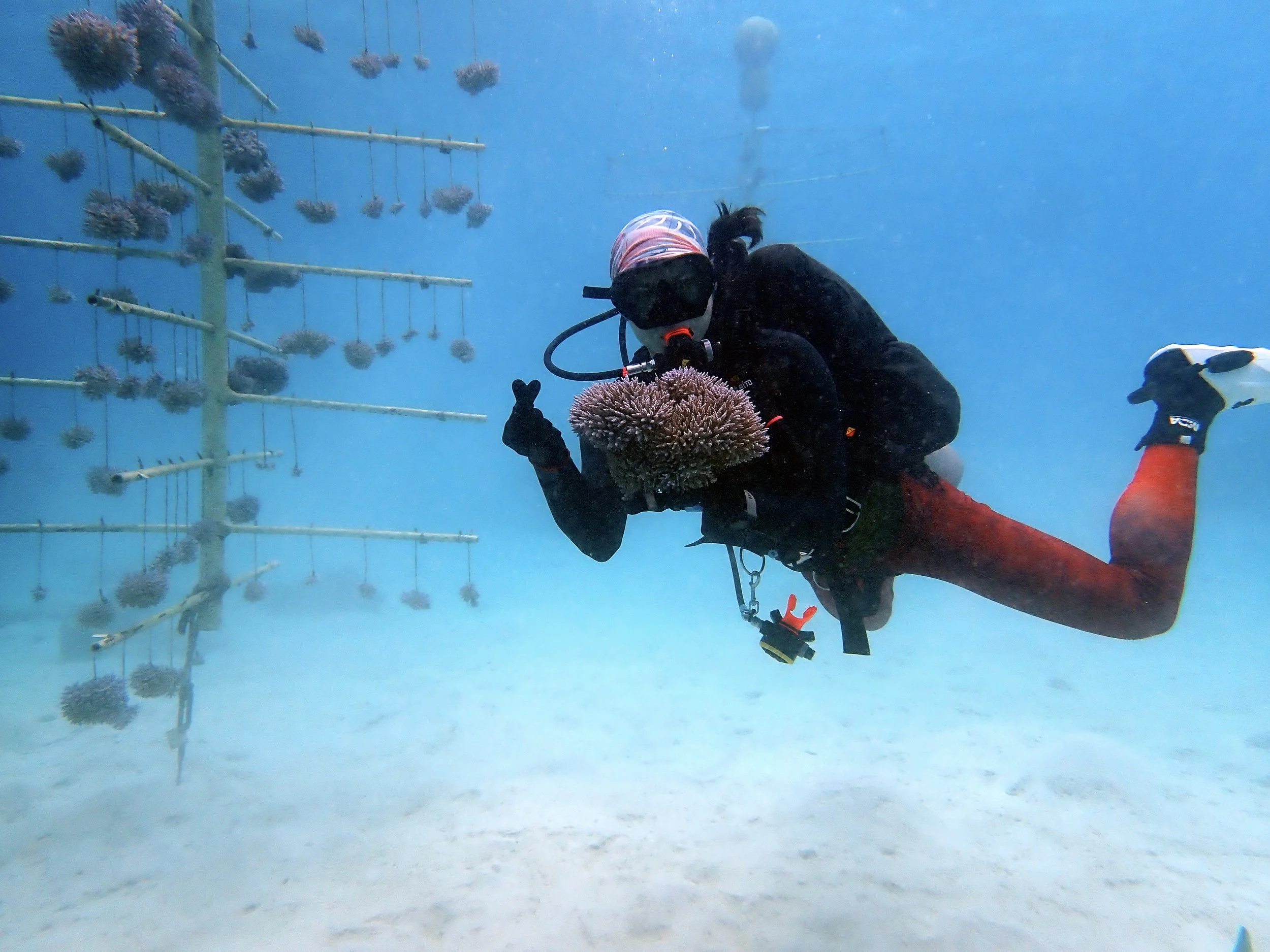
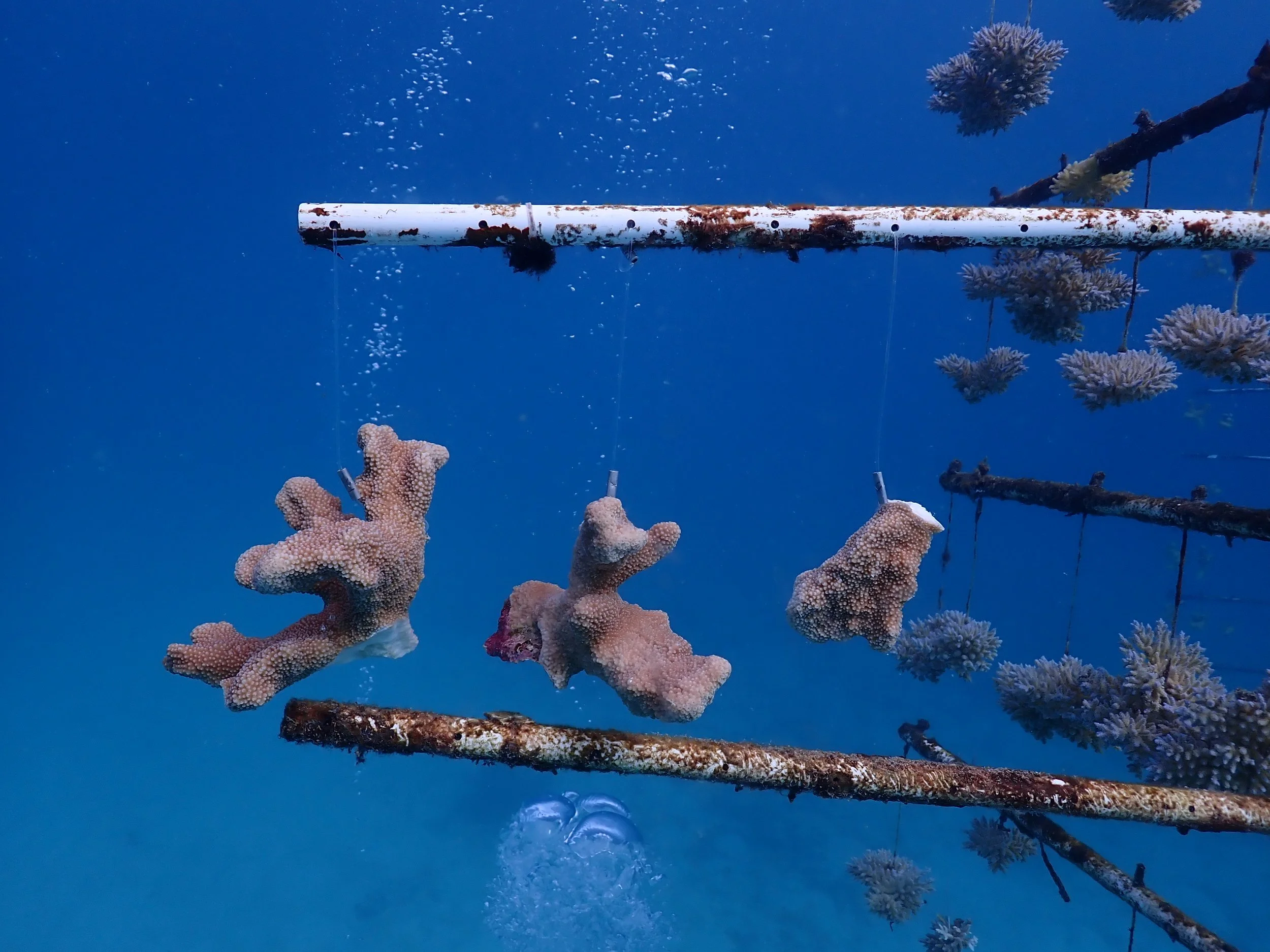
Once the team received the necessary permits, they built and deployed nursery structures to house the coral fragments they would collect. While there are many types of structures used for coral nurseries, GCRI uses a structure called a coral tree, two examples of which are pictured above.
A coral tree, as the name implies, is shaped like a tree with a central trunk and several branches. Coral fragments are attached to the branches, where they have continuous access to high water flow, nutrients, and sunlight.
GCRI uses two types of coral trees: branching trees and wing trees.
Branching trees (pictured on the right) have coral fragments hanging from a piece of fishing line and are best for branching coral types, while wing trees (pictured on the left) have coral fragments growing on a flat tray and are best for boulder coral types.
Once the branching trees and wing trees were built and installed, the GCRI restoration team collected fragments from coral colonies around the island and attached the fragments to the coral trees. The baby corals attached to the coral trees have been growing ever since!
-
Many coral restoration and coral conservation activities, in general, require following legal procedures and obtaining the proper permits and clearance to carry out the activity. Below are the specific permits GCRI obtained to do our coral reef restoration work.
Piti Nursery Permits
Division of Aquatic & Wildlife Resources Special Permit for Scientific Collection/Research
SCR-MPA-25-003
SCR-MPA-24-006
U.S. Army Corps of Engineers POH-2023-00142
Guam Environmental Protection Agency WQC Order No. 2024-02
Dogleg/Apra Harbor Nursery Permits
Division of Aquatic & Wildlife Resources Special Permit for Scientific Collection/Research SCR-MPA-24-006
U.S. Army Corps of Engineers POH-2023-00142
Guam Environmental Protection Agency WQC Order No. 2024-02
DOD License No. N40192-25-RP-00004
Want to learn more? Check out this restoration permitting guide!
Get to know our coral nursery species
GCRI chose 7 species of corals in different shapes and sizes that fulfill different roles on the reef. For example, corals known as “branching corals” have delicate branches that make for great hiding places for fish and other marine species. On the other hand, corals known as “boulder corals” are slower-growing and hardy, and can withstand strong waves from storms. Certain fish or invertebrates like crabs, shrimps, and worms may prefer a certain coral species for habitat or as a food source. The GCRI nursery also houses a few “Corals of opportunity” (COO), which are pieces of coral that have been broken off by storms or human-caused threats, and get a second chance at life growing in the nursery!
-
![Small pinkish branching coral fragment hanging from a string in an underwater coral nursery]()
Acropora uogi (formerly surculosa)
-
![Small dark brown coral growing on a white plastic tray underwater]()
Diploastrea heliopora
-
![Small light brown coral fragment growing on a ceramic plate in an underwater coral nursery]()
Pavona decussata
-
![Small purple branching coral hanging from a string in an underwater coral nursery]()
Acropora latistella
-
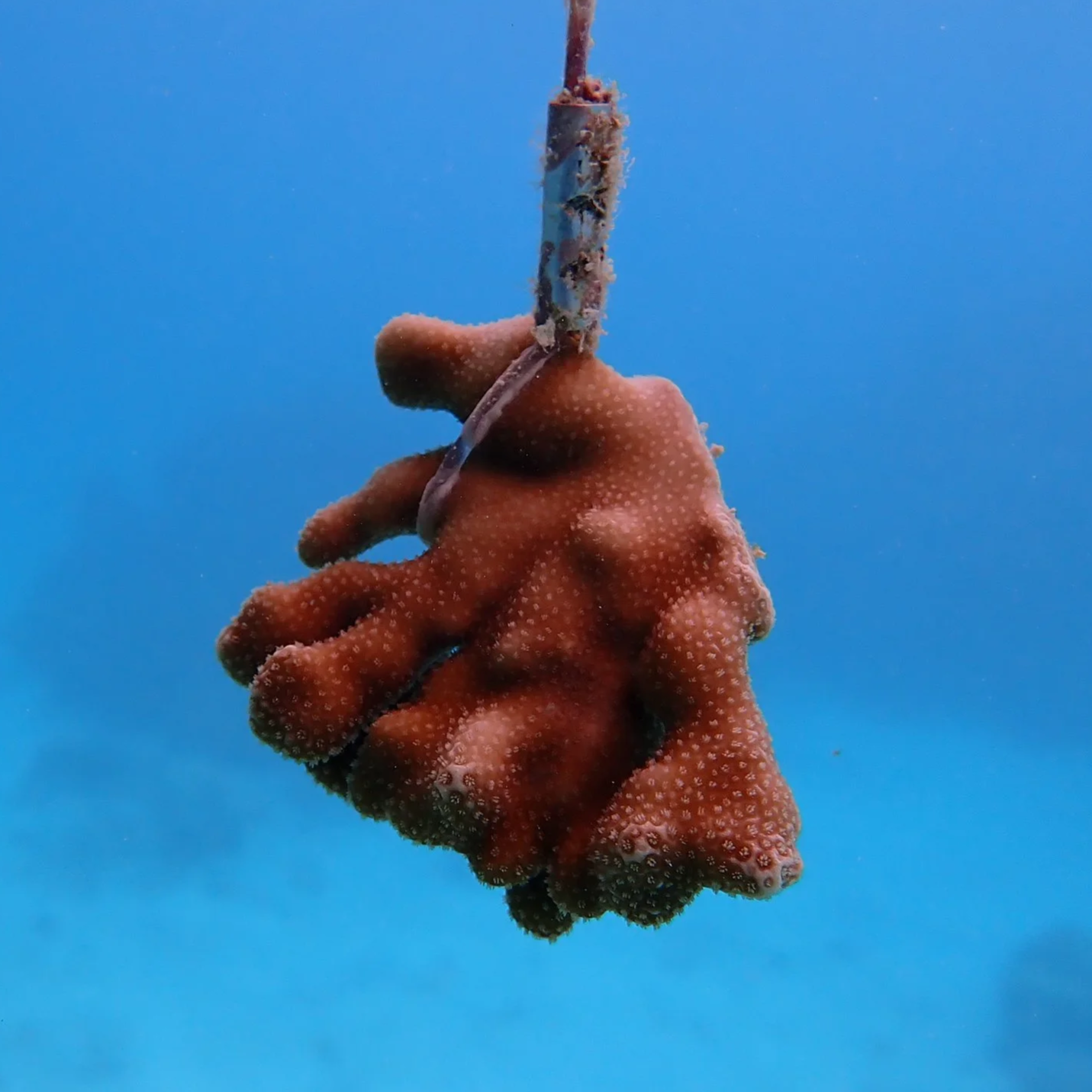
![Several fragments of bumpy brown coral hung by a string on an underwater coral nursery]()
Pocillopora grandis
-
![Small brown coral fragment with tentacles]()
Galaxea fascicularis
-
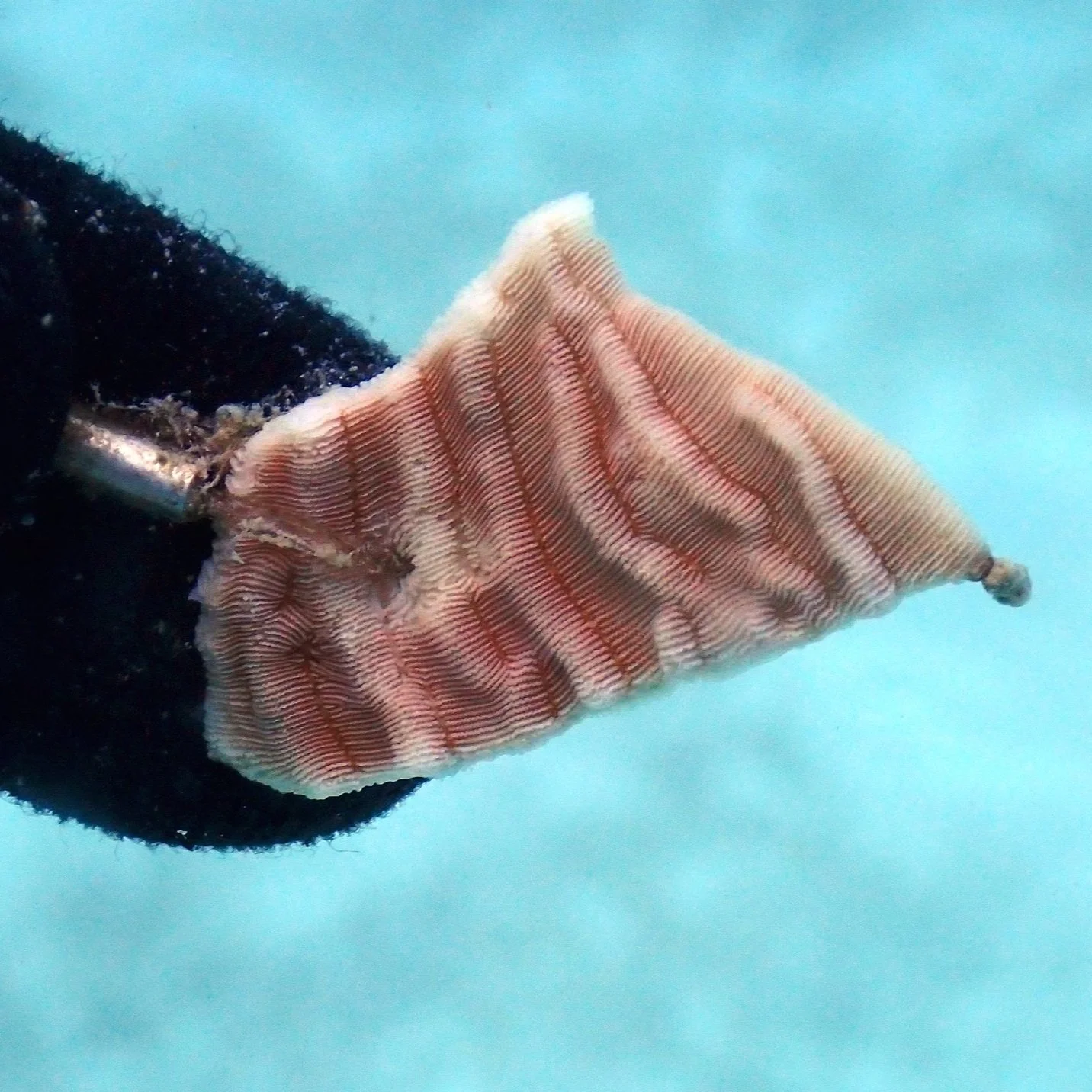
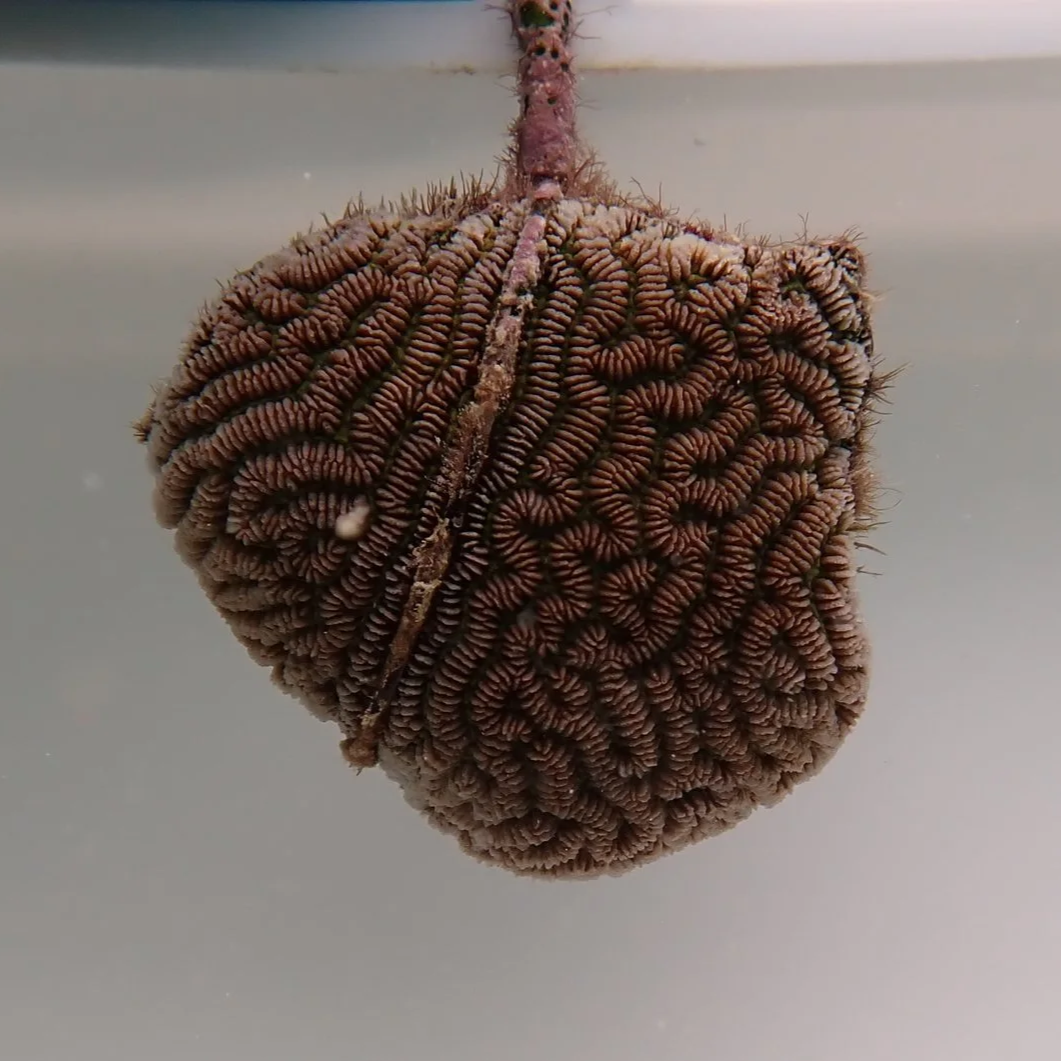
![Small fragment of grey/brown coral with a rippling pattern]()
Pachyseris speciosa
-
![Pinkish fragment of bumpy, branching coral attached to a string]()
Pocillopora sp. (COO)
-
![Small brown fuzzy-looking branching coral fragment hanging from a string in an underwater coral nursery]()
Porites cylindrica (COO)
-
![Brown/purple branching coral fragment hanging from a string in an underwater coral nursery]()
Acropora secale (COO)
-
![Beige/white coral fragment with branches and pointy ends hanging from a string in an underwater coral nursery]()
Galaxea horrescens
-
![Small brown coral hanging from a string in a coral nursery]()
Acropora digitifera
-
![Brown, spiky coral fragment hanging from a string in the GCRI underwater coral nursery]()
Acropora abrotanoides
-
![Light brown coral hanging from a string in the GCRI coral nursery]()
Stylophora mordax/pistillata
-
![Light brown coral hanging from a string in the GCRI coral nursery]()
Psammocora haimiana
-
![Light brown corals hanging from a string in the GCRI coral nursery]()
Isopora palifera
-
![Small brown coral with ridges hanging from a string in the GCRI coral nursery]()
Leptoria phrygia (COO)
-
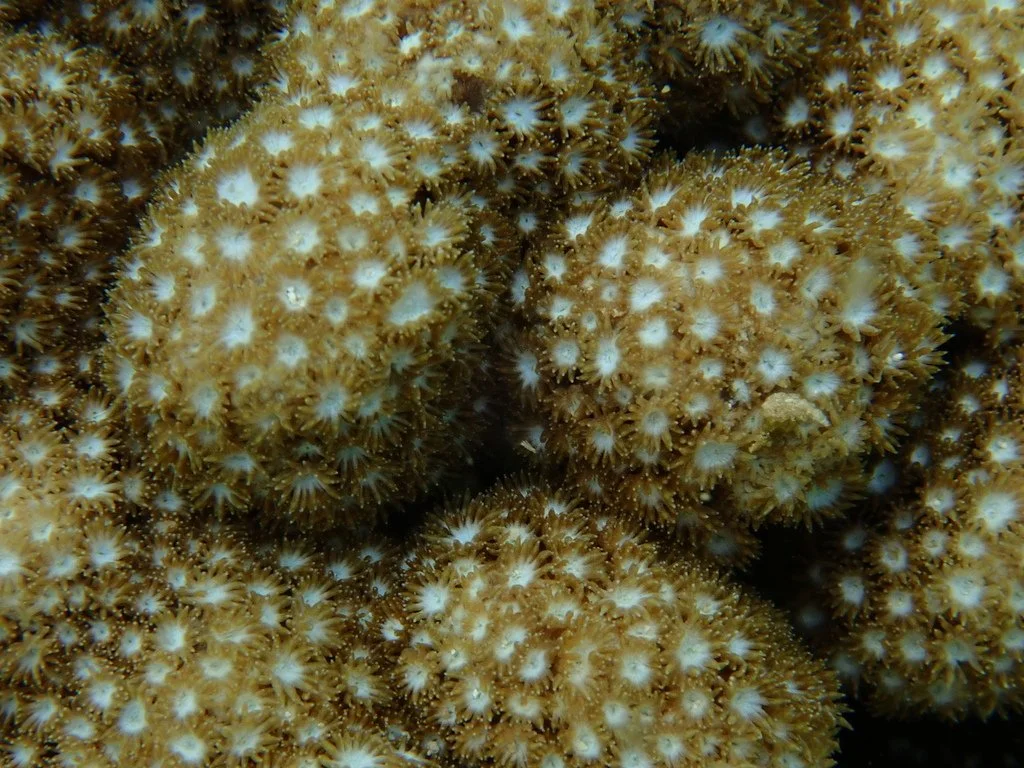
![Colony of lightbrown flower-like corals growing in the wild]()
Goniopora fruticosa (COO)





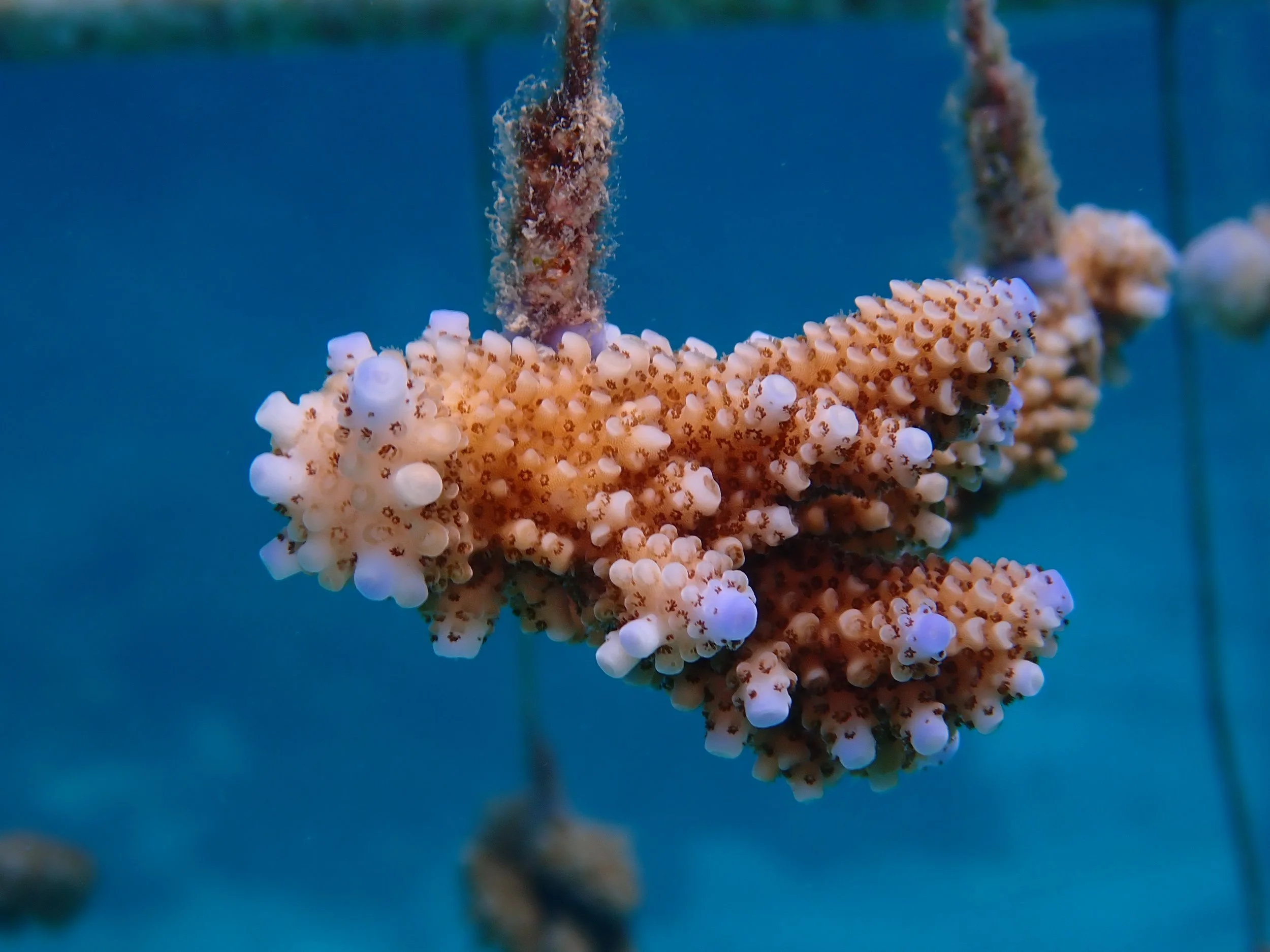
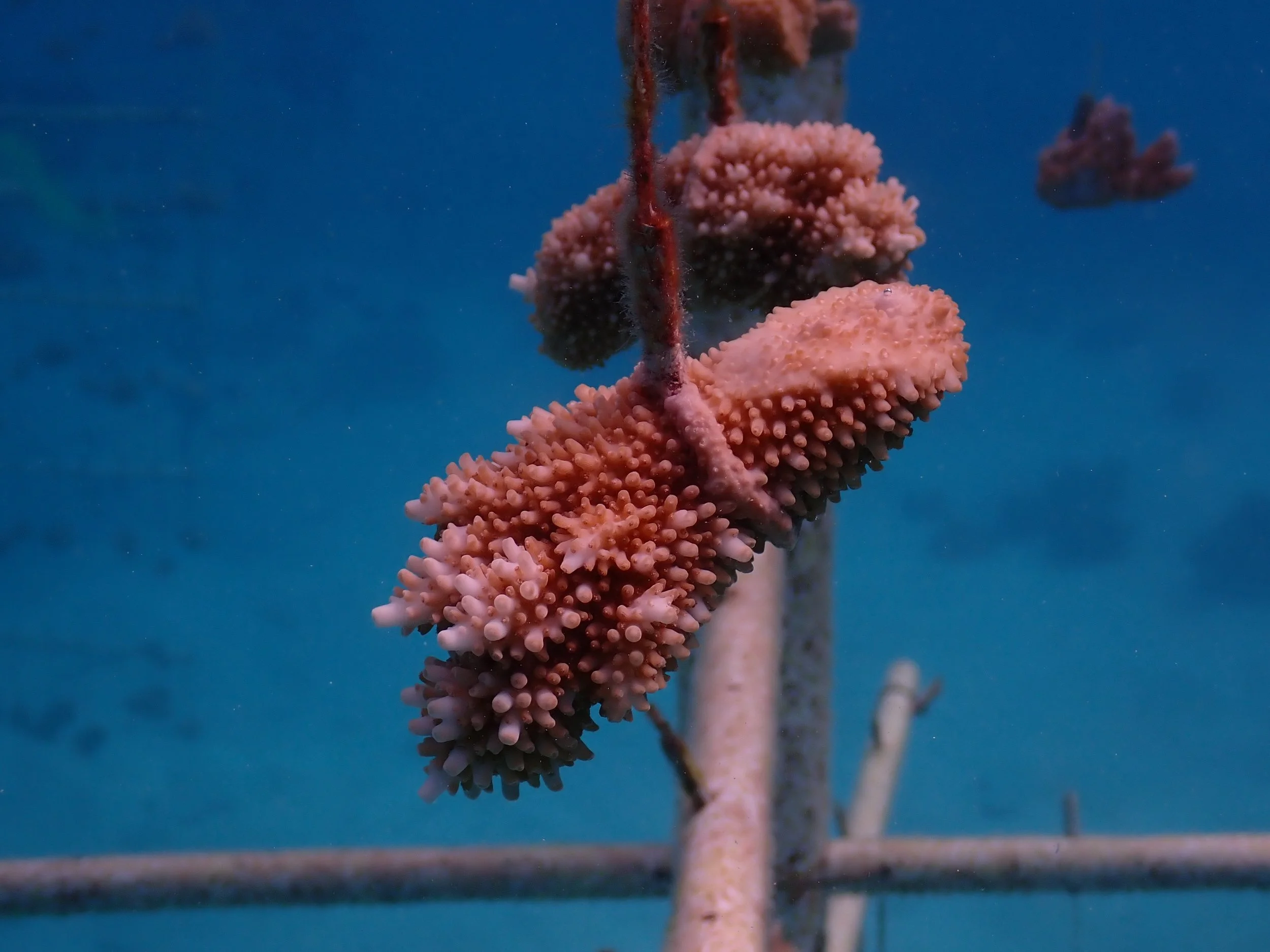
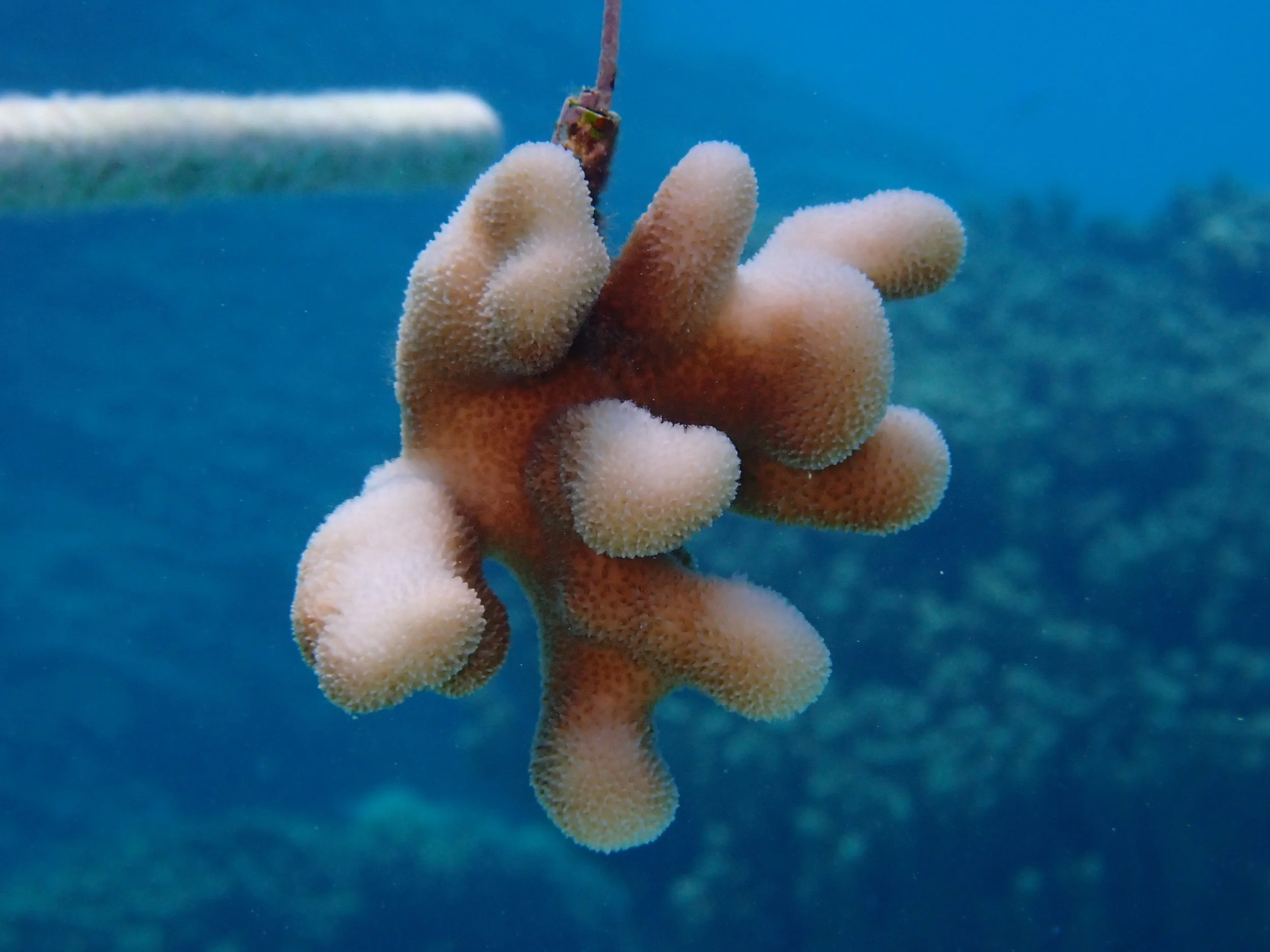
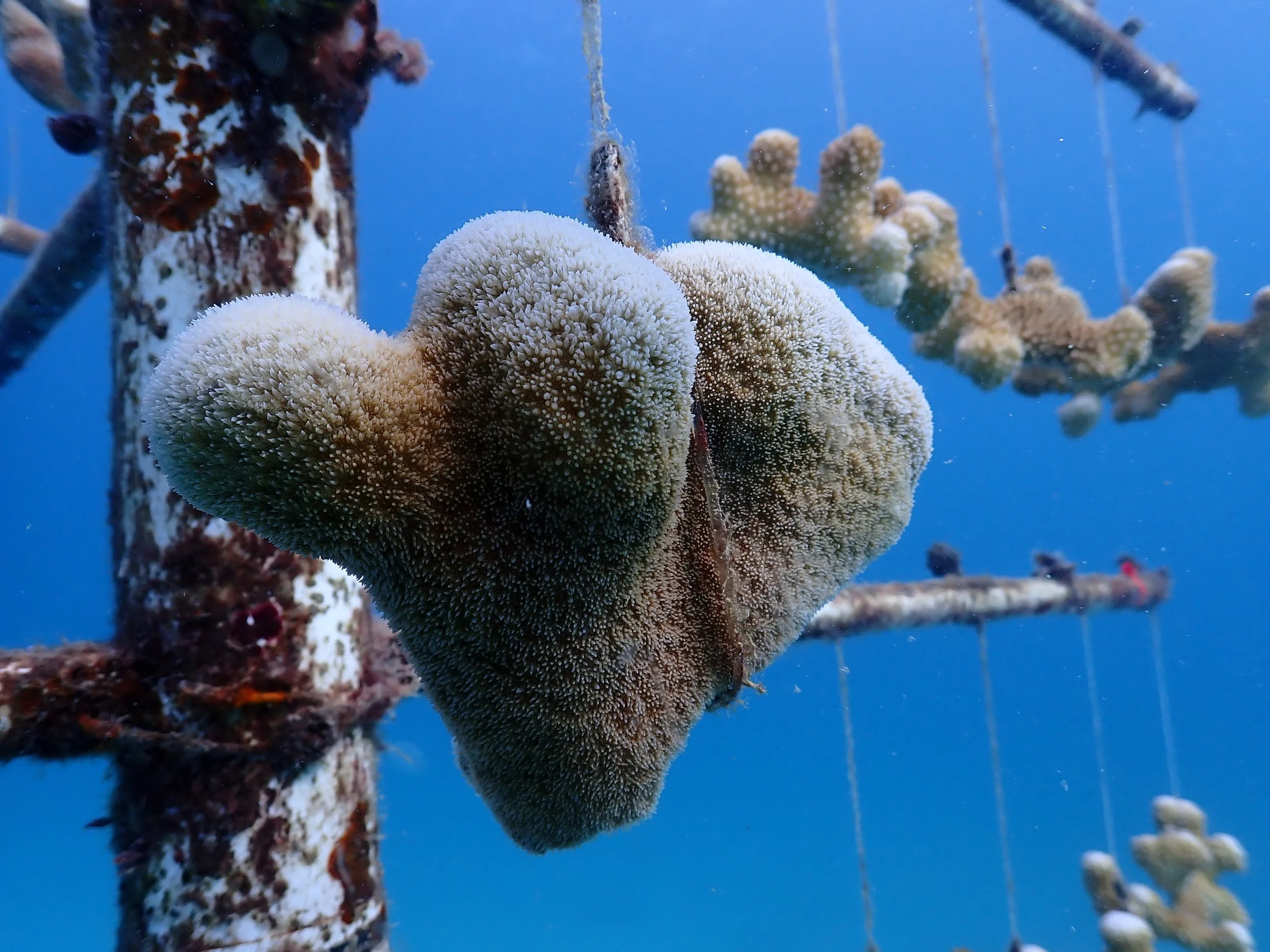
Maintenance

Coral nurseries require maintenance over time, such as the removal of algae, sediment, and other nuisance organisms that may impede the growth of the small coral fragments.
-
The GCRI restoration team has come up with some creative, low-tech solutions to reduce algal overgrowth, including upcycling old toothbrushes to scrub algae off of coral fragments and changing the orientation of the wing tree trays from horizontal to vertical in order to reduce the build-up of sediment.
In preparation for warmer waters and a higher risk for coral bleaching during the summer and fall, the GCRI reef restoration team installs shade cloths over the nurseries to cool down the water around the coral trees. This method has worked well for the UOG Marine Lab’s nursery during past bleaching events, so they kindly showed our team how to install these shade cloths for our nursery as well.
To enhance boulder coral growth by minimizing sediment build-up and algae overgrowth, the team has begun experimenting with hanging a few boulder species, such as G. fascicularis, P. speciosa, and P. decussata. There are several ways to optimize coral growth, and the restoration team is looking forward to the results of these trials!
Monitoring

The GCRI restoration team routinely monitors the health of corals in the nursery as well as the corals they collected fragments from (also known as donor colonies).
-
The team conducts underwater surveys of the corals in the nursery to assess factors such as growth rate, predation impacts, disease, algae overgrowth, bleaching, and mortality. To record this data, the team uses data sheets printed on special underwater paper.
The GCRI team has also been working with a variety of software to obtain growth rate measurements from single photos of coral fragments in the nursery. Hanging corals and trays are photographed over time with a scale bar and analyzed using a model in a computer program that can automatically detect and measure the corals. This process reduces the amount of work needed to obtain accurate measurements of corals, since previous methods involved tracing each individual coral.
Monitoring donor colonies ensures that they don’t sustain any long-term damage from collections and allows the team to compare changes in nursery corals vs reef corals. Monitoring data also helps the GCRI team identify heat-tolerant corals, priority sites for restoration, the health of outplants, and the best methods for growing and collecting corals.
Due to unseasonably warm waters in the fall of 2024, two out of four genotypes of Acropora surculosa bleached. Genotypes are just genetically-different individuals. The respective donor colonies on the reef also bleached, indicating that these colonies happened to be less heat-tolerant. The other two Acropora surculosa genotypes in the nursery and on the reef did not bleach. This highlights the importance of monitoring both nursery corals and donor colonies as well as collecting a variety of genotypes.
Some fragments of this coral species survived in the nursery even when its donor colony did not, serving as an example of coral nurseries acting as a refuge for certain species and genotypes during bleaching seasons.
Collaborative efforts - GCRI has collaborated with scientists testing new, non-invasive technologies and methods to identify heat-tolerant corals, in hopes of informing future decisions on which coral species to grow in the nursery.
Outplanting

Once nursery corals have grown to a mature size, the GCRI team begins the process of outplanting these colonies back onto the reef, bolstering the health and resilience of the ecosystem as a whole. The team has already outplanted several coral fragments from the Piti nursery as a pilot project to test the workflow!
-
Over just a few years, the advancement of technology and the number of digital tools available to coral reef managers and restoration practitioners have increased substantially. One of these tools is called photogrammetry, which allows scientists to obtain information about physical objects and the environment using photographs.
With this method, continuous underwater photos are taken during surveys and can be stitched together in a computer program to create highly accurate 3D models and a wider image of the reef. The GCRI team will be implementing photogrammetry as part of their monitoring methods to measure the growth of outplanted corals and determine the success of restoration.
Why do we do coral reef restoration?
Coral reef restoration provides many benefits to us and the ecosystems we depend on. Check out this infographic to learn more about these benefits, and click below to see the full infographic, including examples of each of these benefits in action. This infographic was created by GCRI staff in collaboration with members of the U.S. Coral Reef Task Force.

GCRI is not the only group doing coral reef restoration in Guam!
The University of Guam Marine Lab has been doing coral restoration since 2014 and has two coral nurseries: one in Piti Bomb Holes right next to the GCRI nursery, and one in the Cocos Island Lagoon. We regularly partner with them to share resources, expertise, and lessons learned.
We also get other local partners involved in our restoration work through the Guam Reef Restoration and Intervention Partnership (GRRIP).
Guam Reef Restoration and Intervention Partnership (GRRIP)

Photo by Ashley Castro
Sharing local knowledge and resources to better protect and steward Guam’s coral reefs
-
GRRIP is a local team of scientists, managers, volunteers, and other concerned citizens involved in coral restoration on Guam. This group is co-led by GCRI and the Raymundo Lab at the University of Guam Marine Lab.
GRRIP includes other partners, including the Bureau of Statistics and Plans’ Guam Coastal Management Program, NOAA, the Guam EPA, the Guam Long-Term Monitoring Program, Fish Eye, and Tano Tasi yan Todu.
As a group, we meet quarterly to discuss updates to coral restoration activities, plan upcoming events, track coral bleaching predictions, and share emerging reef threats that we can collectively respond to as a group.

GCRI’s restoration work is guided by long-term plans developed with input from local partners.
Click below to see existing plans. GCRI is also in the process of developing an updated Guam Restoration Action Plan.
-
![GCRI Coral Restoration Nursery Implementation plan cover]()
GCRI Coral Restoration Nursery Implementation Plan
Want to learn more about our coral reef restoration efforts? Take a look at this plan to see what we do, why we do it, and how we plan to expand in the future!
-
![Guam Coral Reef Restoration action plan cover]()
Guam Coral Reef Restoration Action Plan Goal 1
This plan was originally written in 2021 and was edited and published in 2024 reflecting Goal 1 of GCRI’s coral restoration planning process: restoring reef community structure and function. Goals 2 and 3 of GCRI’s restoration action planning will be developed in the future.